Contributing to Dutch election software at RustWeek 2026
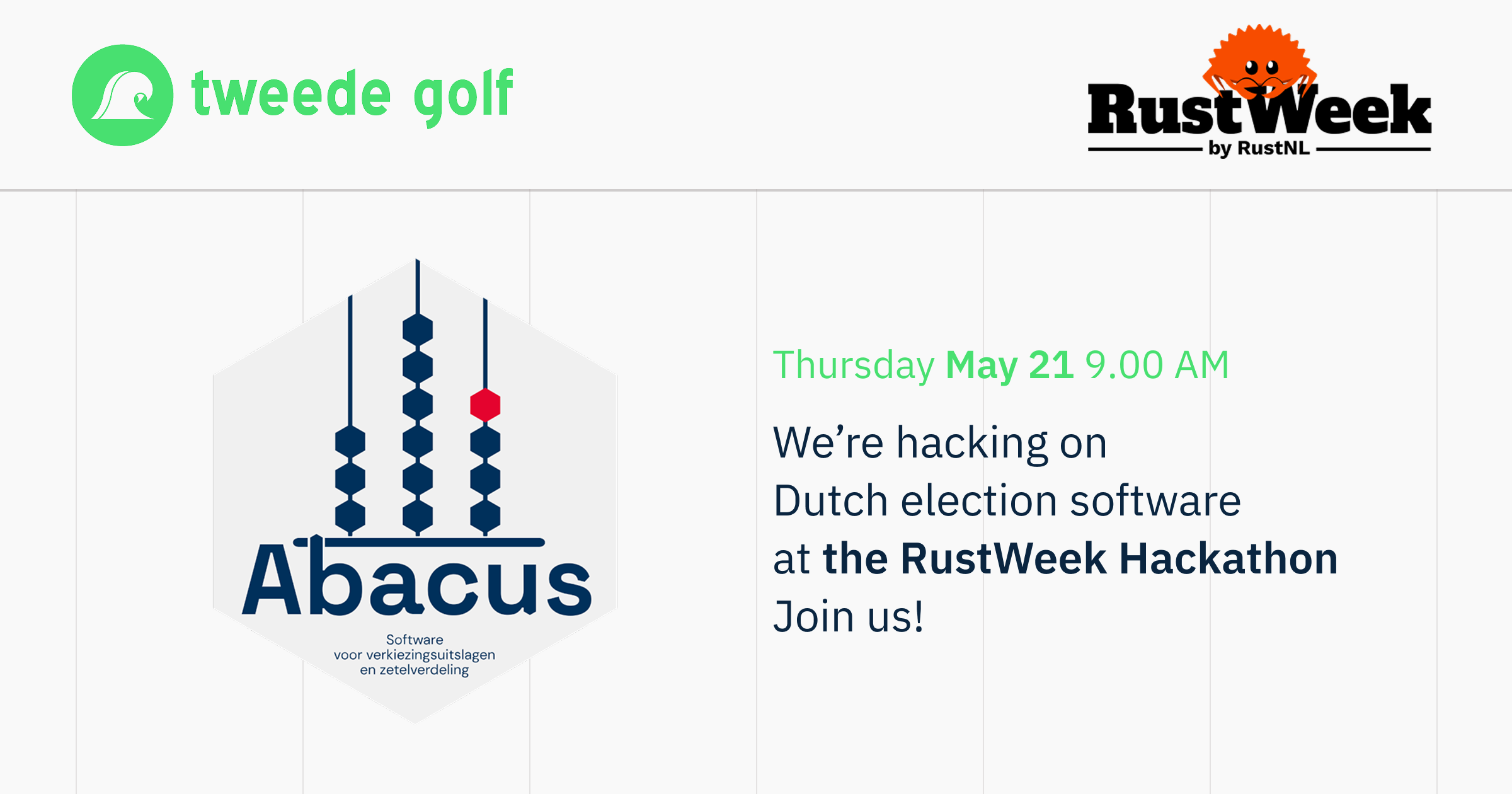
Help us improve Abacus, the in-development software for election results and seat allocation, at RustWeek 2026!
The Dutch Electoral Council
The Dutch Electoral Council (Dutch: Kiesraad) is the independent Dutch authority for all Dutch government elections. The Council's mission is to ensure that the Dutch people can trust the election results.
More info on the Electoral Council and Dutch elections can be found on the Council's Github (in Dutch) and on their official web page.

Abacus: election software
One way the Electoral Council achieves their mission is to ensure that election software exists to verify the manual counting and seat allocation process; Abacus is the latest, in-development implementation of this protocol.
Another key ingredient for trust is transparency, which is one reason why this software (as well as the in-development candidate registration software) is being developed open source; the other being that it is simply required by law.
Not incidentally, the Electoral Council is writing this software in Rust!
What better place to publicly invite external contributions to Abacus than the RustWeek Hackathon!
The RustWeek 2026 Hackathon
Help us improve Abacus by joining the RustWeek Hackathon on Thursday 21 May for an introduction to the project, the team, the Council and the process.
And if you're interested, please consider hacking on Abacus with us during this day!
The Hackathon is free of charge, thanks to sponsorships from The Electoral Council as well as Zed Industries, and takes place on Thursday 21 May 2026.
It is open to everyone; no RustWeek ticket needed!
There are 150 spots, and you can sign up via this meetup page.
How to contribute
To get started, please take a look at the contributing guide. If you want your contribution included in Abacus, you will need to sign a CLA. You can easily do this in person during the Hackathon as well!
What to contribute
Abacus could use your help with anything from small changes to larger proof-of-concept implementations. Take a look at the contributions welcome and good first issue lists for some ideas on where to get started.
Looking for something even more Rust focused? Take a look at our eml-nl crate, and help improve the election data format. Or maybe create your own analysis or visualization using historical election data.
If you haven't found anything to your liking just yet, simply come and have a chat with the Abacus team at the Hackathon!
See you in Utrecht!
We'd love to see you at the RustWeek Hackathon on Thursday 21 May in Utrecht. Expect to find several members of the Abacus team (which consists of both Kiesraad developers and several Tweede golf engineers) on-site.
Either dive into the code, or dip your toes into the waters of Dutch elections; come find us with any of your questions and, hopefully, your contributions, large and small!