Are we mainstream yet? Takeaways from the RustWeek Industry Track
In previous years, the track attracted a relatively select and homogenous audience and the talks often presented one specific but great example of Rust being used in some large organisation. The aim was often to convince others to invest in Rust adoption as well.
This year, we not only opened the talks up to all RustWeek attendees, it also became clear right after the first two talks that Rust is now present in a lot of places, and being adopted much faster than I previously expected in 2024, for example in automotive. The focus has shifted from convincing others about the benefits of Rust, to showing the many places where Rust is now used and zooming in on how exactly various organisations use Rust.
Interest for the track itself also grew, both from sponsors and attendees; Sponsorships sold out months before the event, and the add-ons required to attend the afternoon program sold out weeks in advance.
Below I'll share some of the stories shared during the morning talks, and I'll try to address the question that kept popping up in my head during these talks: Are we mainstream yet?
When is a technology mainstream?
Fair question. In an article I wrote with Matthias Endler in 2024, we discussed the well-known Technology Adoption Lifecycle (see below) and shared our analysis of where Rust was at the time, and where we expected it to go.
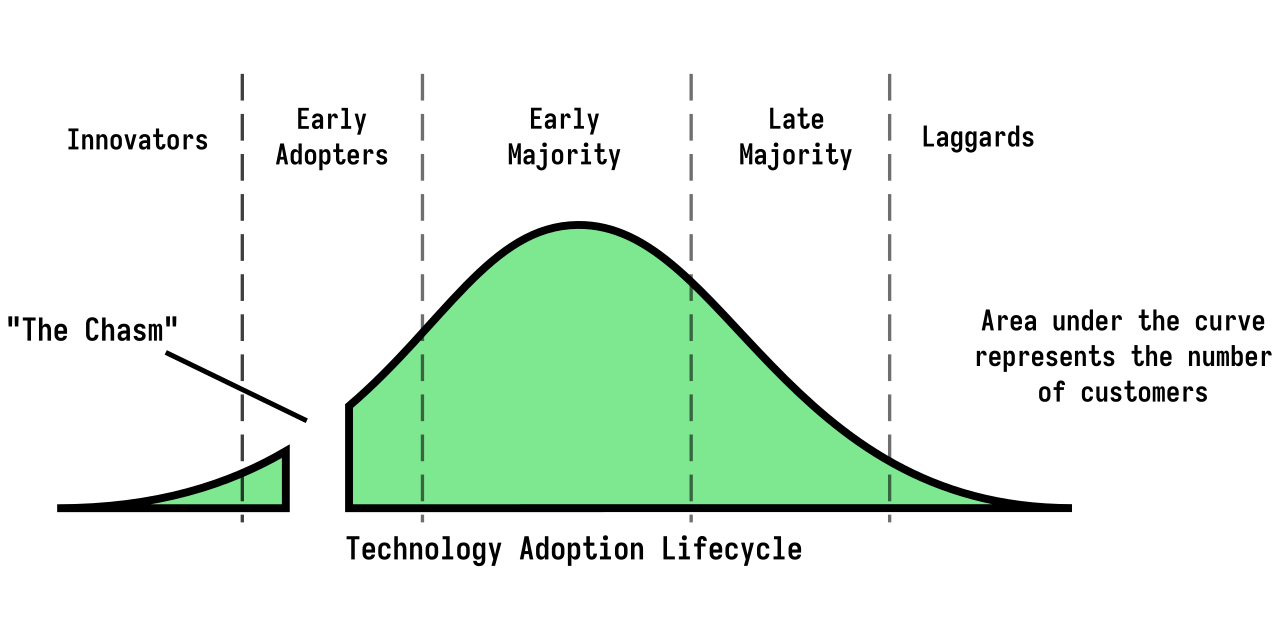 Image: Technology Adoption Life Cycle (image adapted by Matthias Endler)
This lifecycle contains the so-called 'chasm'; a gap somewhere in the middle (or, as sometimes represented, at the end) of the 'early adopters phase' that represents the hardest challenge for any technology to overcome; from appealing to adventurous pioneers, to being trusted enough to expand into other areas. If a technology can do that, it is then said to have become mainstream.
It's not an exact science, but when we say 'mainstream' in this article, this is what we mean.
Popping the Hood on Rust in the 2026 Toyota RAV4
We were honoured that Pete LeVasseur, Staff Software Engineer at Woven by Toyota and Lead of the Safety-Critical Rust Consortium, delivered the keynote about Woven's journey to large-scale Rust adoption.
Pete explained that Rust is used in the vehicle interface (the infotainment and voice agent systems) in what's called the 'unification layer', between the C/C++ vendor code and the UI written with Flutter, enabling the build of a stable unified API layer in an evolving software environment.
Speaking about why they chose Rust, Pete shared that the ability to find or upskill engineers was not seen as a blocker. In fact, they were looking for more modern technology that allowed them to interact with C/C++ while mitigating UB, while at the same time not raising the bar for hiring. I find it interesting that Woven appears to challenge the status quo when it comes to the 'hiring argument' in Rust adoption. Most organisations still see hiring as a big challenge or even a blocker. But not Woven.
Currently a modest 600 of approx 18k software engineers at Toyota Group are working with Rust, and Rust's adoption within the group is still expanding.
This example of Rust adoption within Toyota, combined with last year's Memorandum of Understanding in the German automotive industry, definitely suggests that Rust is on the path to becoming mainstream.
Slides: Popping the Hood on Rust in the 2026 Toyota RAV4
Rustaceans on The Move - The Global Impact of Rust
For the second talk, it was a pleasure to welcome Lori Lorusso, Director of Outreach at the Rust Foundation. She delivered an info-packed talk with the bottom line being "Rust is everywhere and not going anywhere".
In particular, Lori illustrated Rust's current presence in mainstream enterprise infrastructure; showed us that there is a lot of activity in the Safety-Critical Rust Consortium, founded in 2024; and mentioned the progress Rust for Linux is making.
An interesting case study Lori presented is Whatsapp, who rebuilt their core media parsing components in Rust, exchanging 160k lines of memory-unsafe C++ for 90k lines of Rust code. I must admit that I had missed this in January, but it is another great example of reducing attack surface both in terms of reducing the amount of code, and switching to a memory-safe implementation.
Lori's conclusion: Rust is everywhere and here to stay; and yes, to me that indicates that Rust is becoming mainstream.
Slides: Rustaceans on The Move — The Global Impact of Rust
Tales of a transformation journey at Proton
Next, Jeremy Lempereur, software engineer at Proton, shared some of the problems solved, and lessons learned at Proton by adopting Rust.
One way of using Rust that stood out to me, and which Jeremy explained very clearly, is what he calls "common capability libraries": libraries - or 'crates' in the Rust ecosystem - that contain functionality that can be used across different platforms. In Proton's case, that's web, iOS and Android, the common desktop platforms and even on Android and Apple TV.
Following this pattern yields a massive reduction in code duplication, maintenance effort, and in fact, as Jeremy explained, a better user experience in the end. That is because sharing libraries across platforms simplifies ensuring that apps on different platforms work the same way and have a similar look and feel to the end user. This is particularly important for products, like Proton's, that users put a lot of trust in.
This deliberate use of Rust in Proton's privacy and security sensitive products, first of all, signals that Rust is a very good fit to this niche of products. At the same time it shows that, if Rust can be trusted in privacy and security sensitive projects, it can safely build many other types of products as well.
Slides: Tales of a transformation journey at Proton
Scaling up Rust development at the Dutch Electoral Council
In the fourth talk, Mark Janssen, software architect at the Dutch Electoral Council (Dutch: Kiesraad) first gave a recap of their experience using Rust for the backend of the Abacus project, the software for calculating election results and seat allocations.
Most notably, Mark explained that initially they were cautious and realistic about using Rust, expecting at least some challenges, as this was their first Rust project. Using React for the frontend, on the other hand, was seen as a safe choice that wasn't expected to pose any noteworthy problems. Things surprisingly turned out the other way around. Using Rust has been fairly straightforward, while properly using React and trying to minimize dependencies as the application grew caused quite some issues.
Finally, Mark explained that, given their positive experiences with Abacus and with the team becoming proficient in Rust, using Rust for their next project, the new Candidate Nomination software, was a no-brainer. They did, however, drop the use of React for that project, instead opting for a single Rust-native codebase with HTML, CSS and some JavaScript for the frontend.
When a government entity not only uses Rust successfully and in production, but opted to include it in the tender of the following project as the preferred language, we're certainly on the path to mainstream!
Slides: Scaling up Rust development at the Dutch Electoral Council
Rust for Secure and Sustainable Smart Metering
Finally, Ron van der Pols, Tech Lead at Schuberg Philis, concluded the morning program by providing insight into the use of Rust in Nextgen, a large-scale project that is set to replace all (i.e. millions of) smart electricity meters in The Netherlands.
Ron first provided a great overview of how the choice for Rust was made as a result of the high-level project goals and requirements, such as cybersecurity requirements and minimal energy consumption of the new meters. He showed how Java, C and C++ lacked the capabilities they needed, and how Rust checked all the boxes.
Interestingly - and a perfect match to the Industry Track - Ron also discussed a non-technical risk in choosing Rust from the perspective of the vendor: Rust is not the standard choice in metering (yet). This means that, in choosing Rust, Schuberg Philis ran the risk of not winning the tender for that very reason. Their solution: proactively working with procurement and ensuring sufficient buy-in early on in the process. This worked!
Oftentimes, vendors are also reluctant to choose Rust because they assume it's too challenging for their client to take control of the software after the project is delivered. However, at Schuberg Philis, Rust was not viewed as a blocker for the future handover of the software to the distribution system operators, the parties running the grid.
Schuberg Philis chose Rust for its benefits despite the potential risks of its non-mainstream status (such as losing out on a big government contract); because they were confident enough about convincing their stakeholders (rightly so, as it turned out), and because they weren't willing to compromise on the technology (thankfully). To us, this is a clear example of Rust 'jumping the chasm'.
Slides: Rust for Secure and Sustainable Smart Metering
Conclusion
This edition of the Industry Track at RustWeek left me with the very distinct impression that a shift is taking place.
It definitely feels like using Rust is not just for the early adopters and innovators anymore, but also for government organizations, and for use in large and high-stakes projects (such as Woven's and Schuberg's use of Rust). The fact that these parties are betting on Rust for the next decade or longer, says a lot.
So are we mainstream yet? I think so; This year at the Industry Track, we've seen examples of Rust crossing, or even having crossed the chasm.
Let's check again where things stand a year from now when the Industry Track returns at RustWeek 2027, May 24-29 May in Utrecht, The Netherlands. See you then!